Inspection, inventory, traceability: how to finally connect your field operations to your ERP/WMS

A quality check jotted on a loose sheet of paper. An annual inventory that never quite matches the ERP or WMS data. A pallet or vehicle that cannot be located between two sites. Inspection, inventory and traceability share the same blind spot: no ERP or WMS captures what actually happens on the ground – only what is declared to it. And that declaration is usually manual, which means errors, omissions and duplication. A simple no-code mobile app, however, can become the missing interface between your systems and the physical reality of your assets. The case for it, in practice, from Geopost, Findis, Bergerat Monnoyeur and Neubauer.
Inspection, inventory and traceability are processes designed to capture, verify and track the real state of assets in the field. In practice, though, things are usually messier. An auditor copying up a paper form in a hurry at the end of the day. A fleet manager reconciling a spreadsheet against a physical count once a year, hoping the discrepancies stay manageable. A loading-bay supervisor unable to prove that a pallet actually went onto the right lorry. Three different roles, three different tools, one shared problem: the data that matters – an asset's condition, its location, visual proof of a check – exists in no information system at all.
ERP and WMS platforms handle theoretical data well: a declared stock level, a reference, a quantity. What they rarely manage is capturing real data as it exists in the field, when it happens. Their native mobile apps, where they exist, tend to allow little more than entering a number against a reference. Rarely can they photograph an item's condition, record its precise location within a multi-site warehouse, or attach the proof that would head off a dispute later. The result: teams work around the tool. Paper, a shared spreadsheet, a WhatsApp group the IT department never sanctioned. The data exists – just nowhere it can be put to use.
Inspection, inventory, traceability – these three use cases really come down to one question:
How do you provide feedback, in real time and with proof, on what the ERP cannot see?
These are not theoretical use cases: WizyVision already runs them across more than 40 active applications, in three specialist sectors, with a working proof of concept delivered in ten days and teams present in 20 countries.
Inspection: the audit process in your pocket, with proof attached
A QHSE audit, an ISO compliance check, a store visit: three use cases, one identical pattern. An operator spots a problem or an abnormal situation on site, has to document it, then report it to a team that isn't there in person.
How? Usually by noting the anomaly on paper or in a rigid mobile form. The chain then breaks at every step: illegible notes, photos taken on a personal phone with no link back to the file, re-keying in the evening by an already overstretched quality manager. In short, a largely manual process that raises the risk of error, omission, loss or misunderstanding.
At Chronopost, temperature-controlled delivery – food, medicines, vaccines via Chrono Fresh – is a fast-growing business but a tightly regulated one: without ISO certification, operating in this market isn't possible. Depot audits (hygiene, safety, ISO compliance) are therefore business-critical, not a box-ticking exercise.
A first attempt at digitising the process had failed: field teams found the mandated tool cumbersome and largely rejected it, while it remained complex to administer. With adoption lacking, auditors kept running their checks on Google Sheets, laptop in hand, with no centralised view of corrective action plans.
With WizyVision, adoption followed the opposite logic – bottom-up rather than top-down. Depots already used the app daily for checklists, so moving to audits meant no new habits to learn. In the field, auditors – and depots themselves, for their self-assessments – now work from a smartphone, with colour-coded forms, alerts for skipped fields, and photo capture plus voice dictation to document a non-conformity in seconds. WizyVision automatically generates and centralises corrective actions and calculates audit scores without manual work.
See how Chronopost uses WizyVision to check its refrigerated boxes
The result: 25 audit and self-assessment checklists (hygiene, safety, ISO and more) deployed across 160 depots, in production since July 2024 after a four-month initial rollout. The ISO certifications the temperature-controlled business depends on are secured.
Discover our Inspection & Audit applications →
Inventory: two distinct problems for high-value assets
Not every business needs to count screws and bolts one by one. At WizyVision, field inventory makes the most sense for high-value assets: vehicles, construction plant and attachments, IT equipment, industrial machinery, and so on. Within that scope, two problems recur, year after year, across almost every supply chain and finance department.
The periodic inventory, under the auditor's eye
At least once a year, a physical check is unavoidable; statutory auditors require it, and so do insurers. And every year, the same finding: recurring gaps between the ERP register and the fleet's physical reality. The reason is almost always the same: the ERP's native mobile app lets you enter a figure against a reference, but rarely the asset's condition, and never its exact location. A damaged, moved, or missing item stays invisible until someone physically finds it.
A photo changes that. The operator photographs the asset, the AI automatically extracts the serial number or registration plate, captures the geolocation and assesses its visible condition – wear, rust, damage. The gap between theoretical and actual stock becomes an automatically generated report, rather than a manual, last-minute scramble the week before the audit.
See how inventory works with the WizyVision solution
Tracking in/out movements and transfers between sites
The second problem is more insidious: tracking an asset's day-to-day entries, exits, and internal transfers between sites. Businesses running a multi-site fleet – sales, rental or a mix of both – regularly lose track of where their equipment actually is.
This is especially true for high-value mobile assets:
- Construction plant and attachments (a digger bucket changes site as often as the digger itself);
- Vehicles;
- Test equipment…
Here too, ERPs don't offer a field mobile app suited to the need: they manage a stock movement in theory, but rarely the reality of a physical transfer witnessed by someone on site.
Bergerat Monnoyeur, a Caterpillar dealer, illustrates this problem well: high-value plant and attachments scattered across multiple sites. In the automotive sector, Neubauer, a leading distributor, has entrusted WizyVision with tracing its equipment, from parts receipt through to tracking test and diagnostic equipment in the workshop.
In both cases, the principle is the same: every physical movement – leaving the depot, arriving on site, transferring to another location – is captured by a time-stamped, geolocated photo, logged directly against the asset's record.
Discover our Equipment Inventory applications →
Advanced traceability: the visual proof that ends disputes
Traceability isn't just a barcode scan. On a loading bay, in a warehouse or on a factory floor, the same question keeps coming back: can you prove what actually happened?
What this changes on the ground:
1. A pallet photographed at the back of the trailer, with the number plate visible, ends the classic carrier dispute: ‘You never loaded my pallet.’
2. A systematic photo of the compliant pallet, automatically linked to the order number, clears a retail-chain logistics penalty in seconds, rather than trawling through an SD card that only gets cleared once a week.
3. Damage photographed on receipt, with automatic extraction of the shipment number, turns an illegible handwritten note into a usable incident file in seconds.
Geopost, through its DPD, Pickup and Chronopost brands in France, has deployed a no-code app that can identify the contents of an unreferenced parcel from a single photo. The result: visual stock-taking now twice as fast, with customer satisfaction on claims up threefold, across 3,000 users in 20 countries.
Findis, France's leading B2B home-equipment distributor, has cut its delivery non-conformity disputes by deploying two no-code apps, one on receipt and one on dispatch: the purchasing team now has real-time access to visual proof to raise documented supplier claims.
Discover our Advanced Traceability applications →
WizyVision: the interface between your systems and the field
Inspection, inventory, traceability: in all three cases, WizyVision replaces neither the ERP nor the WMS. The platform sits exactly where these systems fall short – capturing the event in the field – and feeds them more reliable data in real time.
Two distinct, complementary contributions:
- Better-quality data, faster, in your existing systems. The operator takes a photo, the AI extracts and structures the information (reference, condition, location), and the data flows straight through to the ERP or WMS, with no double entry and no administrative delay.
- An enriched database the ERP cannot hold. Time-stamped, geolocated photos, a full history of an asset's movements, its visual condition at every stage: this qualitative layer, accessible through a dedicated web and mobile interface, answers the day-to-day operational questions – a dispute, an audit, a search for an asset – that an ERP register, by its nature, cannot document.
| Field need | What the ERP/WMS alone does | What WizyVision adds |
|---|---|---|
| Annual inventory | A theoretical figure per reference | Photo, condition, location, automatically generated variance |
| Inter-site movement | A declared stock movement | Time-stamped visual proof of the physical transfer |
| Quality control/audit | A paper form or a tick-box | Automatic PDF report, geolocated proof, tracked CAPA |
| Transport or delivery dispute | No usable proof | Indexed photo, retrieved in seconds |
Use cases by industry
What these businesses have in common isn't the sector: it's the presence of high-value assets or processes, scattered across the field, whose condition, location or compliance has a direct financial or regulatory impact. In practice, inspection, inventory and traceability play out differently from one industry to the next.
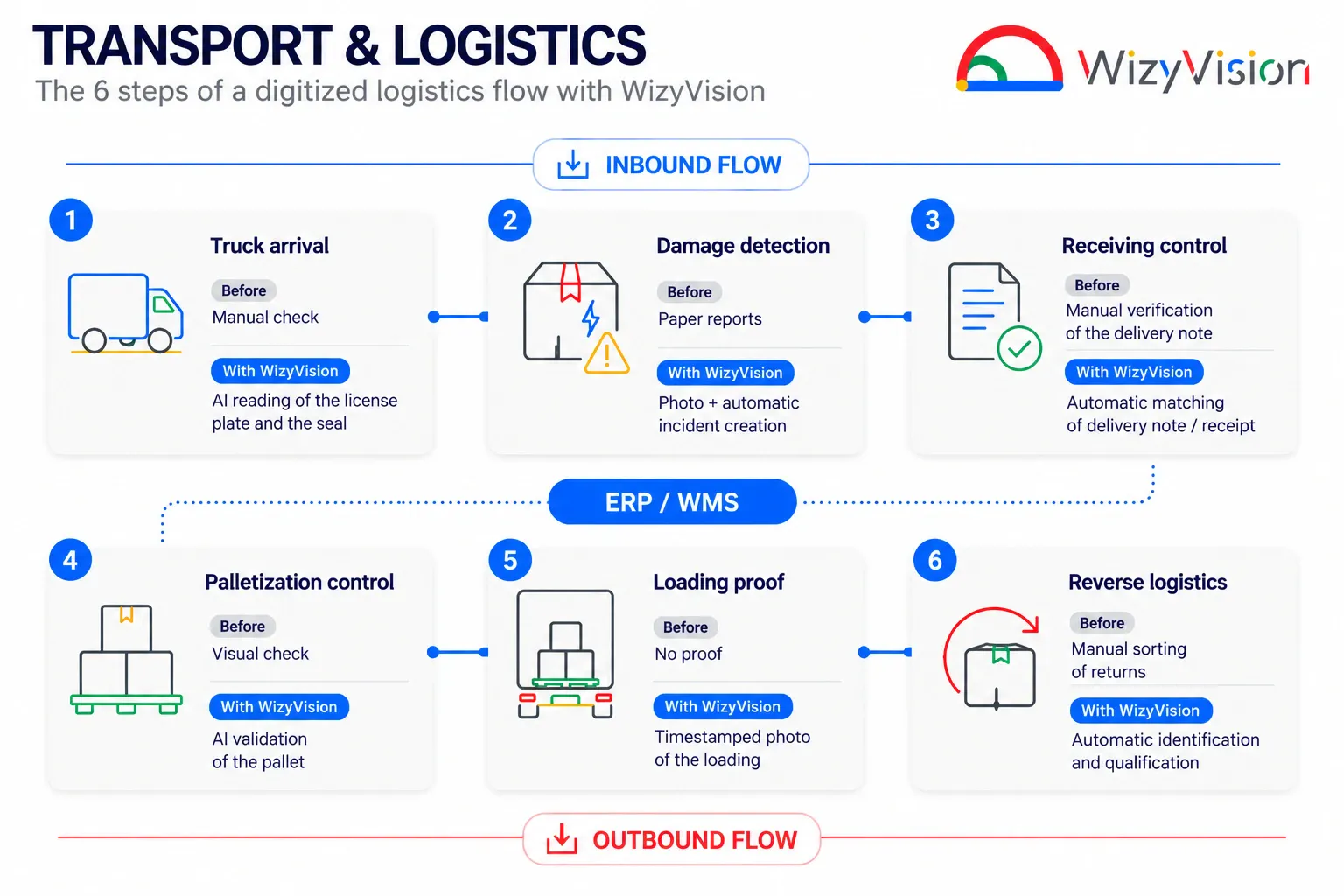
Transport & Logistics
The sector where the handover point is constant: the parcel or pallet changes hands at every stage.
Who trusts us:
- Chronopost has digitised its quality audits (see above);
- Geopost (DPD, Chronopost, SEUR, BRT) tracks its unidentified parcels across 20 countries;
- STEF (temperature-controlled transport specialist);
- Mondial Relay…
Discover our Transport & Logistics solution →
Here, the core business is the handover: the parcel or pallet changes hands at every step, from the lorry's arrival through to returns. On the loading bay, everything happens in seconds: a photo of the seal and the lorry's number plate at arrival secures legal traceability, where a verbal exchange or a photo lost in a WhatsApp group used to be enough.
When a pallet arrives crushed, the '3-second damage report' replaces the illegible handwritten note with an indexed incident file, complete with the shipment number extracted automatically.
On loading, a photo of the back of the trailer, with the number plate visible, confirms delivery of the pallet — a dispute still too often settled in the carrier's favour for lack of proof.
The same principle applies to administrative receipt (the paper delivery note photographed and matched automatically against the expected receipt) and to returns: a parcel identified in seconds by photo rather than sorted by hand in a 'returns corner', with an automatic alert to customer service as soon as an anomaly is detected.
Industry, Energy & Utilities
Here, the challenge is regulatory compliance and reliability in constrained environments: gas, electricity and water networks, industrial sites sometimes with no signal at all.
Who trusts us:
- Orano;
- Teréga;
- Veolia;
- KAEFER (industrial services)…
All these organisations deploy safety-inspection and field-documentation apps in some of the most demanding environments, including nuclear facilities.
Discover our Energy & Utilities solution →
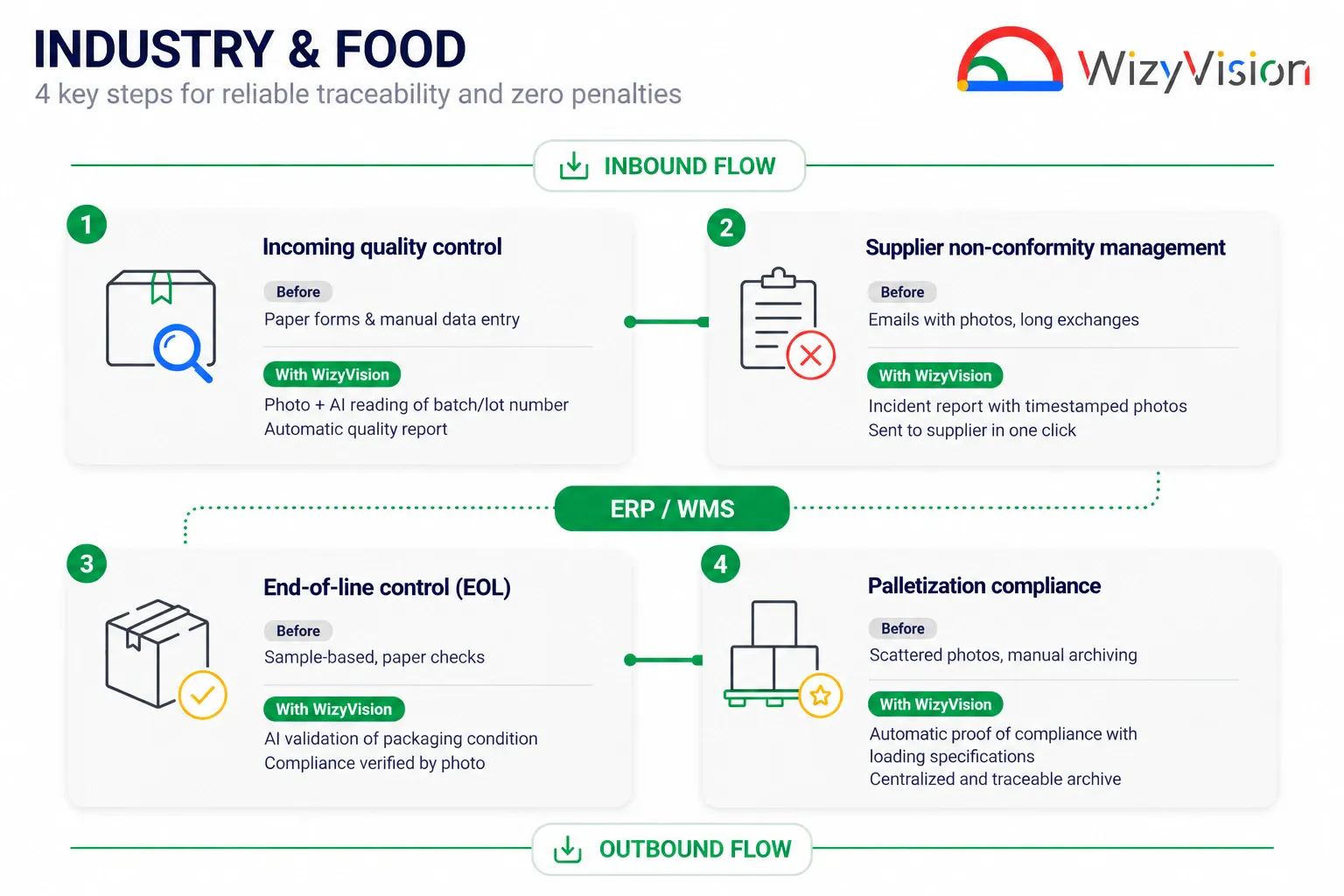
The same need shows up in industry and food manufacturing, where the priority is strict batch and expiry-date traceability, and 'zero penalties' with retail chains. On receipt of raw materials, a photo of the batch and the manufacturer's label is enough for the AI to extract the batch number and use-by date and generate the quality report — where the operator used to fill in a paper form, re-keyed that evening by the quality manager. For a supplier non-conformity, a time-stamped incident link, sent in one click, replaces the long email full of photos, and is enough to put invoicing on hold while the dispute is resolved.
At the end of the line, the same photo habit validates packaging conformity against the manufacturing order. And to avoid retail-chain penalties, the Digital Asset Center links every pallet photo to the order number: enough to clear a penalty running into several hundred pounds with a three-second visual search, rather than trawling an SD card that only gets cleared once a week.
Retail & Distribution
Here, the challenge is delivering a consistent experience across the whole network, from point of sale to delivery.
Who trusts us:
- Schiever (Groupe U) and Moët Hennessy (LVMH) use WizyVision daily for their field visits and audits;
- Findis has cut its delivery non-conformity disputes by digitising receipt and dispatch (see above).
Discover our Retail & Distribution solution →
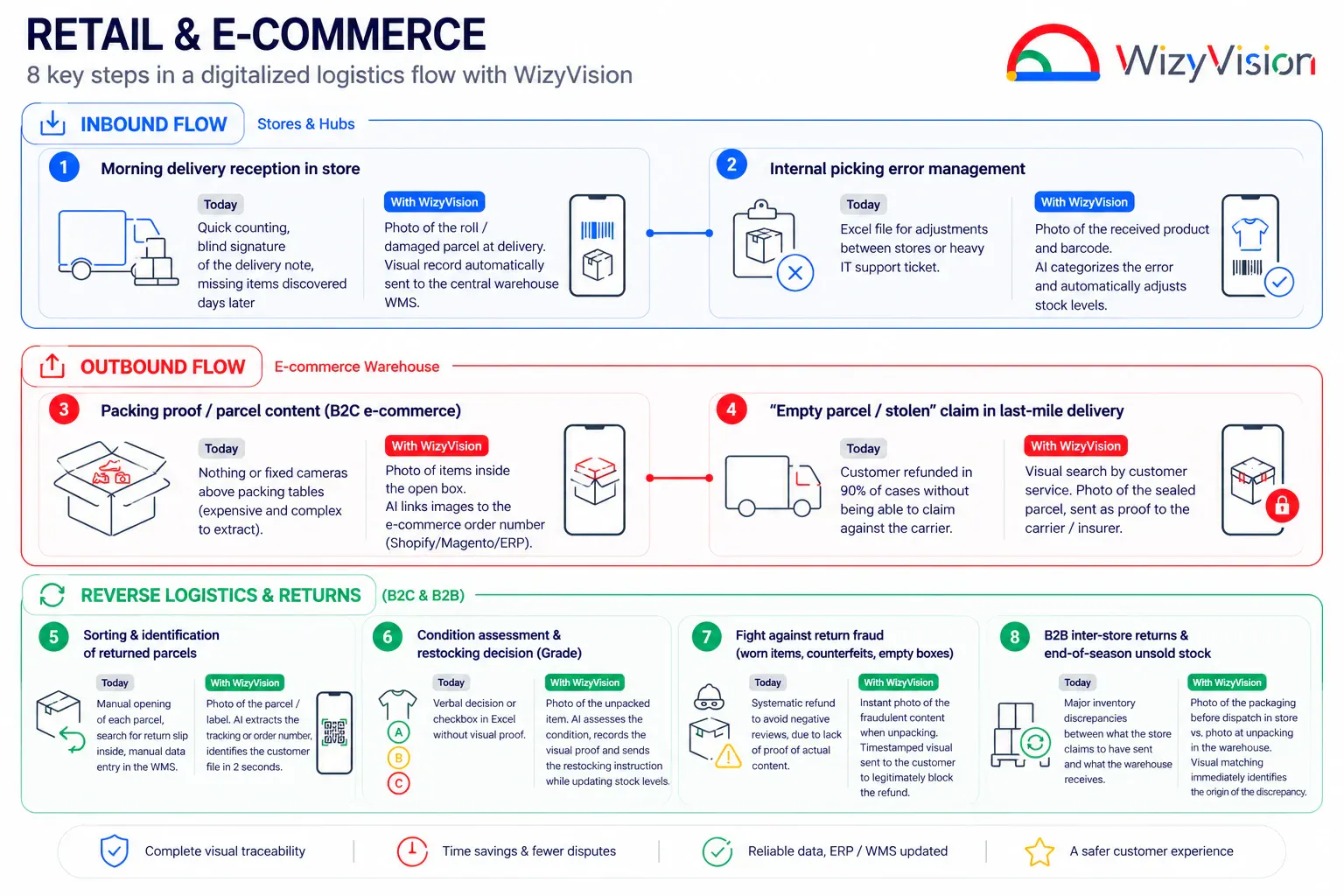
In retail and e-commerce, speed of execution, managing high volumes of returns, and coordination between the central warehouse, stores and end customers are the main challenges — and the use cases are plentiful.
On receipt in store, a damaged roll cage or parcel is scanned and sent straight to the central warehouse's WMS, rather than signed for blind, with any shortfall only discovered on the shelf three days later.
For high-value parcels (luxury goods, electronics), a photo of the contents before the box is sealed heads off 'empty box' disputes at last-mile delivery — a claim that currently pushes customer service to refund in 90% of cases, for lack of proof to put to the carrier.
At high-volume returns, the same photo habit changes the scale of the problem:
- A parcel identified in seconds rather than sorted box by box, by hand;
- An item graded (A, B or C) with visual proof, rather than a box ticked blind;
- And usable proof in cases of returns fraud (a worn item, an empty box) that replaces the automatic refund granted just to avoid a bad review.
Construction & Automotive
Two sectors dominated by high-unit-value asset inventory, with one thing in common: fleets scattered across multiple sites or workshops, hard to value with a simple spreadsheet.
Who trusts us:
- Bergerat Monnoyeur, a Caterpillar dealer, illustrates the problem well. Plant and attachments — a digger bucket changes site as often as the digger itself — move constantly between depots and sites, with an ongoing risk of 'ghost assets': equipment still on the books, insured and depreciated, but nowhere to be found in the field.
- In the automotive sector, Neubauer, a leading distributor, has entrusted WizyVision with the traceability of its equipment, from parts receipt through to tracking test and diagnostic equipment in the workshop.
What happens without real-time traceability:
- 25% of the budget for new equipment purchases goes on replacing what has been stolen or lost.
- On average, a business takes 25 days to locate a missing asset.
- For 98% of businesses, searching for assets is a daily or weekly task: more than 10 hours a week, the equivalent of one full-time employee for three months.
- In 77% of cases, a missing critical asset caused a significant stoppage or delay over the past 12 months. 1
In both sectors, the principle is the same: the AI automatically extracts a vehicle's number plate or chassis number (VIN), or a machine's serial number, captures the geolocation, and assesses its visible condition: wear, rust, damage.
Enough to cross-check field scans against the accounting register in minutes, eliminate the ghost assets that waste money on tax and insurance premiums, and produce a theoretical-versus-actual dashboard rather than an annual treasure hunt.
Discover our Equipment Inventory applications →
Summary: the problem, the solution, the ROI impact
In summary, here's how each critical step of the logistics flow is transformed with WizyVision:
| Supply chain step | The pain point | The value WizyVision brings | Direct ROI impact |
|---|---|---|---|
| Lorry arrival/seals | WhatsApp / paper register | AI photo (plate + seal) | 100% legal traceability |
| Damage on receipt (In) | Illegible paper form / lost photos | AI photo + automatic delivery-note extraction | Zero lost supplier disputes |
| Quality control (IQC/CTQ) | Paper form / double entry | Visual capture + batch number/use-by date extraction | 2 hours/day saved per controller |
| Trailer loading (Out) | Theoretical WMS (“scanned at the bay”) | Visual proof inside the trailer | End of false claims |
| Retail-chain dispatch | Camera + SD card on a PC | Digital Asset Center (AI search) | Logistics penalties eliminated |
| Reverse logistics/returns (retail & 3PL) | Loose parcels, slow grading, unprovable fraud | AI unboxing photo + auto identification + grade qualification | -50% sorting time + end of returns fraud |
The Existing Solutions Landscape: Where Does WizyVision Fit?
Faced with these pain points, five broad categories of tools compete for attention today. None covers the whole need on its own, which is why so many businesses still juggle several tools, or fall back on paper.
WMS, ERP and TMS Platforms
SAVOYE, Reflex WMS (Hardis), Manhattan Associates, Generix Group, SAP EWM, Infor, Oracle: these platforms manage the theoretical flow — stock, orders, transport — but were never built to capture a photo, a non-conformity or a physical condition in the field.
Generic no-code forms
Kizeo Forms, SafetyCulture (iAuditor), Ermeo, and Sweekli digitise the paper form but remain data-entry tools: no built-in AI to extract data automatically, and no native link to the ERP or WMS.
Camera gates and fixed vision systems
Cognex, Keyence, Hikvision, or solutions such as Scallog capture an image at a fixed checkpoint. Effective for very high-volume flows, they represent significant CAPEX and don't cover mobile checks: the condition of a parcel, a piece of equipment or a load.
Light/mobile-first WMS
Stockagile, ZetesMedea, BizzON, and Monstock address lighter inventory needs but, like conventional WMS platforms, remain more focused on theoretical data than visual proof.
Improvised tools
WhatsApp Business, Microsoft Teams, SharePoint or a shared spreadsheet: by far the most common option in the field — and the least traceable, least secure, and least usable for the ERP.
WizyVision doesn't replace any of these categories; it fills the blind spot common to all of them –reliable, structured, provable capture of the field event, with a native link to your existing systems.
Detailed step-by-step comparison
Here, step by step through the logistics flow, is how these solutions handle the need today, why it remains a limitation in the field, and what WizyVision changes:
| Step to digitise | Existing competing solutions | How they handle the need today | The WizyVision difference |
|---|---|---|---|
| Lorry Arrival Check (plate, seal, trailer) | WMS/TMS (SAVOYE, Reflex, Manhattan), Camera gates (Cognex, Hikvision), Forms (Kizeo) | Keyboard entry too slow on a PDA. Camera gates are costly (CAPEX) and fixed: they can't see the seal at the back of the lorry. Kizeo doesn't extract data automatically. | Mobile AI photo in 3 seconds. The AI extracts the plate and seal, timestamps it and sends it to the WMS with no manual entry. |
| Receipt & Damage on Unloading (In) | WMS (receipt module), WhatsApp/Teams, Kizeo Forms | WMS platforms handle photos poorly (heavy to attach). WhatsApp means scattered, unsecured data with zero link to the ERP. Kizeo PDFs get lost in emails. | Instant Damage Report. A photo of the damaged parcel/pallet: the AI reads the SSCC/delivery note and creates the ERP incident ticket with the indexed photo. |
| Paper Delivery Note vs Actual Matching (In) | Document management/OCR (Basware, ABBYY, YouDoc), Handheld scanner/gun | Forces the operator to leave the bay to scan at a desk. Standard OCR struggles with creased or dirty documents straight off the lorry. | Field Mobile OCR. The operator photographs the delivery note on the bay with a smartphone or gun. The AI extracts the line items and matches them directly against the WMS. |
| Receipt Quality Control (IQC/Batches/Use-by Dates) | ERP/WMS quality module (SAP, Reflex), Ermeo/SafetyCulture | Double entry (paper on the bay, then a PC in the evening). The operator has to type the batch number and use-by date by hand. | AI Visual Capture. The AI reads the manufacturer's label, extracts the batch number/use-by/best-before date, validates conformity and completes the quality record. |
| Palletising Check & Penalty Avoidance (Out) | Digital camera + PC server, ZetesMedea/Viapost | Photos named “IMG_0042.jpg”, impossible to link to an order number without hours of filing. | Digital Asset Center. A photo of the compliant pallet linked to the order number. In the event of a retail-chain penalty, the photo is retrieved in 3 seconds through visual search. |
| Proof of Loading Onto the Lorry (Out) | WMS (“scanned at the bay”), fixed bay cameras | The scan doesn't prove the pallet is actually in the lorry (risk of a bay mix-up). Pulling 3 minutes of footage from a CCTV server takes customer service 2 hours. | “Back of Trailer” Proof. A photo of the loaded lorry's interior with the plate visible. Fully secures against “never loaded” disputes. |
| Returns Sorting & Identification (Reverse) | WMS returns module, manual Excel entry | Mountains of loose parcels, a very slow process. Many anonymous parcels (label torn off) stuck for weeks. | AI Identification. A photo of the return label, even if damaged. The AI finds the customer record in 2 seconds and generates the receipt note. |
| Grade Qualification & Anti-Fraud (Reverse) | Spreadsheet/paper form, automatic customer-service refund | Zero proof of condition on unboxing. No way to stop fraud (a customer returning a worn garment or an empty box). | Instant photo of the contents on opening. Usable proof sent to the customer or insurer to legitimately withhold the refund. |
Frequently Asked Questions
No. WizyVision connects to your existing systems via REST API and feeds the ERP or WMS with better-quality data. It doesn't replace them.
Conclusion
Inspection, inventory and traceability aren't three separate projects: they're three symptoms of the same gap between your information systems and the physical reality of your operations. In all three cases, the method that works is the same: start not with an IT specification, but with a concrete use case.
At WizyVision, this method comes down to three steps: a half-day scoping session to align on the operational promise, a working proof of concept in ten days tested directly by your field teams — proof before commitment — followed by a phased, site-by-site rollout, integrated with your existing ERP, CRM or WMS, without disruption.
This approach, applied one application at a time, starting with the most painful use case, is what allowed Geopost, Findis, Bergerat Monnoyeur, and Neubauer to measure impact before scaling up: more than 40 active applications today, across three specialist sectors, deployed in 20 countries. So why not start with yours?
Sources
- 1Samsara, State of Connected Operations: Asset Theft & Loss Report, July 2026 ↩
More blog posts like this

Building your own field app with generative AI: good or bad idea?
Laurent Gasser
CEO

How do you choose the right no-code solution to create the mobile apps your field teams need easily?
Laurent Gasser
CEO

Maximize Productivity: How To Choose the Best Platform for Building Mobile Apps
WizyVision Team